One of the strangest things about arriving back in the United States after nine years abroad, is the immersive fear-mongering and know-nothingism of the 24-hour news cycle. It is like watching a train wreck that never stops and it is very, very hard not to rubberneck.
I am not someone who ignores the news. Quite the contrary. But as someone who typically gets his news from selective reading, guided by my highly curated twitter feed and specialist sensibilities while avoiding anything that reeks of “breaking news”, the constant schadenfreude of MSNBC-FOX-CNN is nauseating.
And yet, after the police killings of two black men in two days—Philando Castile in Minnesota and Alton Sterling in Louisiana—followed by the killing of five police officers in Dallas by a sniper at a peaceful protest rally, I’ve been watching too much of it, hearing too much of it, to the point where I am afraid.
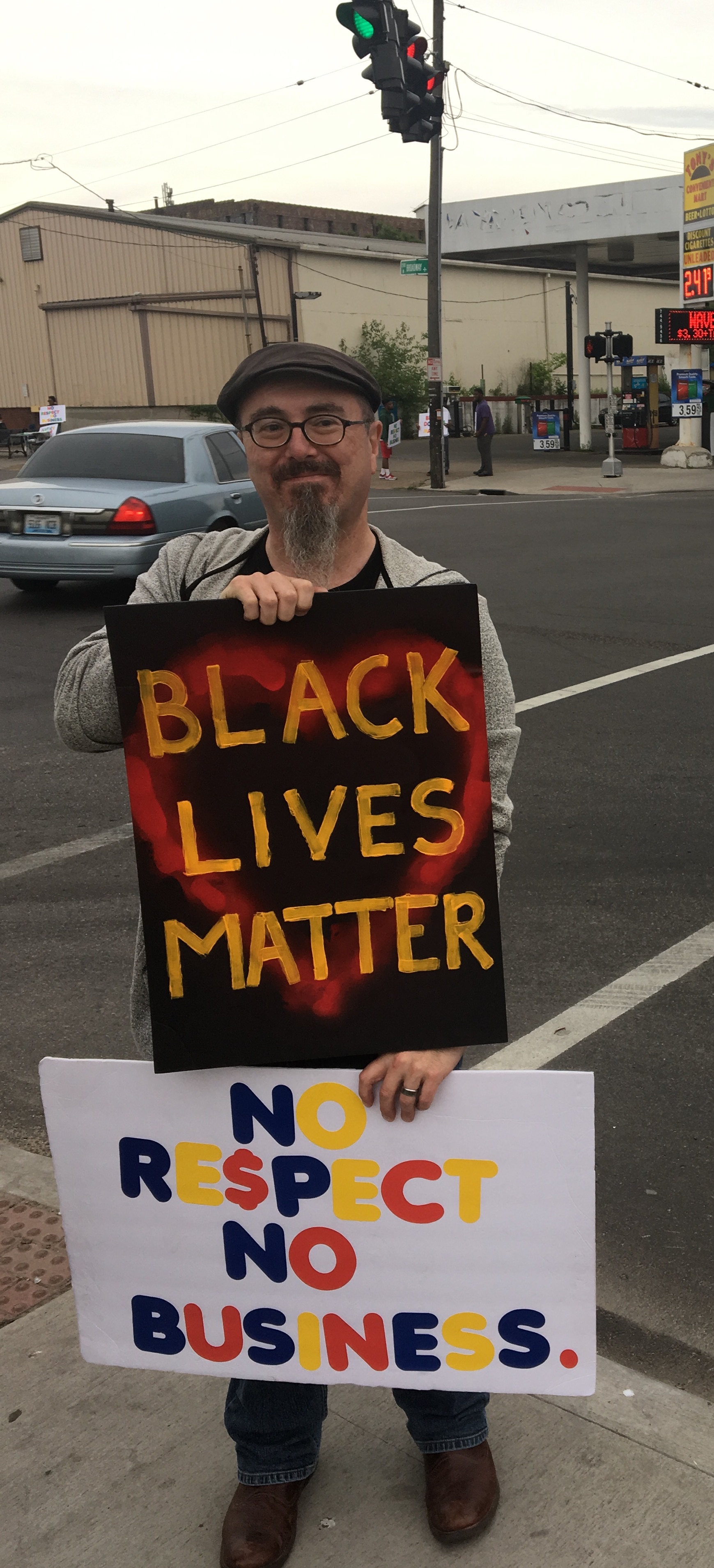
Let me be clear: I support Black Lives Matter and related movements unequivocally.
Let me be clear: I don’t support targeted killing of police (or anyone else) by snipers, bombs, drones, robots, tasers, beatings or neglect.
Let me be clear: Protest, even raucous, confrontational protest that engages and channels the righteous anger of a community is not the same thing as killing, shooting, targeting. It is protected political activity and a precious right.
I am overwhelmed by the courageous, poised testimony live-streamed by Diamond Reynolds while her boyfriend, Philando Castile, was shot and killed by a police office after being pulled over for a broken taillight and then informing the office (as he was legally obligated to do) that he was carrying a concealed handgun (for which he had a permit). (Trigger warning: You can read an abbreviated account here http://www.alternet.org/news-amp-politics/harvard-psychologist-explains-how-diamond-reynolds-stayed-calm-and-livestreamed).
As the officer shot Castile multiple times, and he was dying in the car next to her, Reynolds livestreamed the aftermath, her daughter in the backseat, remaining calm and taking care of not only herself and her daughter but in effect the police officer as well—a police officer who is audibly losing it on the recording. She literally makes the recording while the officer is menacing her with his sidearm, freaking out, and failing to render emergency aid to the man he had just shot.
The Washingon Post interviewed Jim Hopper from Harvard, an expert on trauma, who explained that Reynold’s calm as she livecast while assuring the officer that she will keep her hands where he could see them was an “understandable” response to a horrific situation, in which parts of the brain—presumably the parts responsible for panic—shut down.
Yes, that’s obviously within the range of the possible or it wouldn’t have happened. Both panic and almost uncanny calm can be seen in the aftermath, or even in the midst, of trauma. I won’t speak to Hopper’s work—I’m not familiar with it—but the Post’s use of his scientific commentary serves to take an extraordinary act and present it as something ordinary. There may be good reason for this. Maybe for the sake of some clueless person who might interpret her response as unfeeling or callous—a person both lacking in imagination and who didn’t listen to the entire recording. Maybe just because newspapers have to print something.
Fear is complicated. People are complicated. They react in all sorts of unpredictable ways to situations that become all the more unpredictable in interaction with other people who are also unpredictable. Training is intended to make people more capable of reacting to crisis situations predictably—without panic. It doesn’t always work.
Black men in particular (and among others) have long(!) had reason to fear the worst from any encounter with the police. The technology-facilitated revelation of this reality to a wider population has created a stir, raising incredulity first, then anger, and now growing frustration. The killing of cops in Dallas will raise fear in a wider circle. Specifically fear of increasing reactionary violence from increasingly heavily armed and militarized police forces.
Here is some out of context data:
Number of police officers killed by intentional civilian gunfire in 2015: 39
Number of civilians killed by police gunfire in 2015: 990
Number of police officers killed by intentional civilian gunfire in 2016 to date: 22
Number of civilians killed by police gunfire in 2016 to date: 509
(Statistics for police deaths from the Officer Down Memorial Page; for civilians killed by police by the Washington Post.)
It’s worthwhile to look at the fine grain of the Post data (click on the little figures that represent each and every incident). For the 2015 data, 730 are classified as “Attack in progress.” No doubt many of these, I haven’t run a case-by-case analysis, might be described as responses to civilian driven violence in direct protection of the public or self-defense. But far too many of them are akin to this:
“David Wheat Jr., a 22-year-old white man armed with a knife, was shot on July 18, 2015, in an apartment building in Fort Collins, Colo. Two Fort Collins police officers, called to find an intoxicated and suicidal man, shot Wheat 11 times when he refused to drop a kitchen steak knife.”
Or this:
“Richard Perkins, a 39-year-old black man with a toy weapon, was shot on Nov. 15, 2015, in a gas station in Oakland, Calif. Oakland police were towing vehicles after a car show. Perkins approached officers and pointed a realistic-looking toy gun at them.”
Or this:
“Tyrone Bass, a 21-year-old black man armed with an unknown weapon, was shot on Sept. 15, 2015, on a street in Chalmette, La. Bass struggled with a St. Bernard Parish sheriff’s deputy and struck the deputy on the head. A second officer shot and killed Bass.”
Situations where patience, training in crisis de-escalation and non-violence, calling for back-up, avoiding unnecessary confrontations and so on could (in hindsight and without knowing the details) have meant one less killing.
Black Lives Matter. Stop the Killing!